


Announcing SBC Cloud Foundation
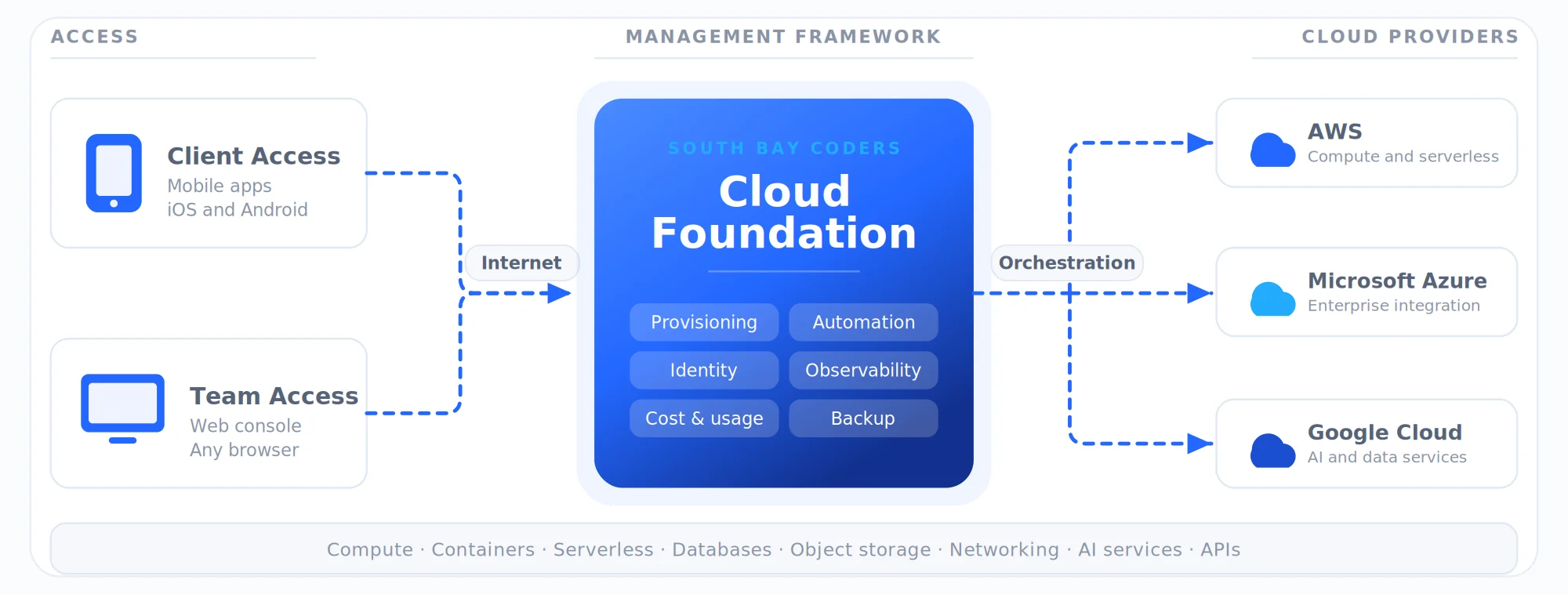
South Bay Coders is building its own Cloud Foundation — a unified management framework to provision, operate, monitor, and manage cloud resources across Amazon Web Services, Microsoft Azure, and Google Cloud Platform from a common operating environment.
As infrastructure becomes more distributed, organisations are frequently pushed into choosing a provider, a management platform, and an architecture up front, and then living with the cost and operational complexity that follows. We are designing around a different premise: manage the cloud as one distributed operating environment.
One foundation, multiple clouds
The objective is not simply to support multiple clouds. It is to operate them as a unified SBC environment — with provisioning, identity, security, observability, cost visibility, and backup handled once rather than three times.
Why we are building it
Cloud applications do not always need to live entirely inside one hyperscaler. A workload might benefit from AWS compute, Azure enterprise integration, or Google Cloud AI services, chosen for their economics or their technical fit rather than because of where the account already sits.
The application determines the infrastructure. The infrastructure does not dictate the application.
Making enterprise capability affordable
Small and midsize organisations increasingly need what used to be enterprise-only: highly available applications, cloud databases, AI services, secure APIs, monitoring, backup, scalable compute, object storage, disaster recovery. Traditional architectures get expensive when every workload is deployed onto the same premium stack regardless of what it needs.
Cloud Foundation lets us assess resources across providers and build distributed architectures around the customer’s actual requirements. Use the right cloud, use the right resource, pay for what the application actually needs.
What the framework centralises
- Provisioning and automation for both applications and infrastructure
- Multi-cloud resource management with health and availability monitoring
- Usage and cost visibility across every provider in one place
- Security policy, logging, and observability applied consistently
- Backup, recovery, and lifecycle management as standard rather than per-project
Individual workloads stay distributed. Operational visibility stays central.
The conversation this changes
Cloud projects usually open with “which cloud are we deploying to?” We would rather open with “what does this application actually need?” and work outward from there to the right combination of compute, storage, database, networking, AI, and security services.
For some customers that is AWS. For others Azure or Google Cloud fits better. For more involved environments it is a distributed combination. The customer does not have to manage that complexity — we manage the foundation.
Built for what we ship next
Cloud Foundation also gives our own teams reusable services for compute, storage, databases, APIs, authentication, AI, monitoring, messaging, security, backup, and automation. Less time rebuilding the same infrastructure for every new application, more time on the capability a customer actually asked for.
What comes next
Development continues as we expand the management, automation, observability, security, and orchestration capabilities. The goal is a straightforward one: deliver enterprise-class cloud applications and infrastructure without requiring an enterprise-sized cloud budget.
This is not an attempt to become another hyperscaler. It is a management foundation that lets us use the best of what the hyperscalers already provide, and deliver it through a simpler, more flexible, and more affordable operating model.
One framework. Multiple clouds. Infrastructure built around the application.