

Hera Phase Two: The Mobile Platforms, Unveiled at LA Tech Week
At LA Tech Week this October, South Bay Coders is unveiling the second phase of the Hera Family Planning development journey: the mobile platforms. It is the part of the product our own usage data had been asking for since the first month the web platform went live.
Tech Week is a decentralized format — a16z presents it, but every event on the calendar is hosted independently by a company, fund, or community, spread across the city over seven days. Los Angeles runs 12–18 October 2026, directly after the San Francisco week. That structure suits this kind of announcement better than a stage at a single conference does: the people who care about a fertility matching platform going mobile are clinicians, agency coordinators, and founders building in adjacent parts of health tech, and in a decentralized week you can actually get them in one room.
What phase one established
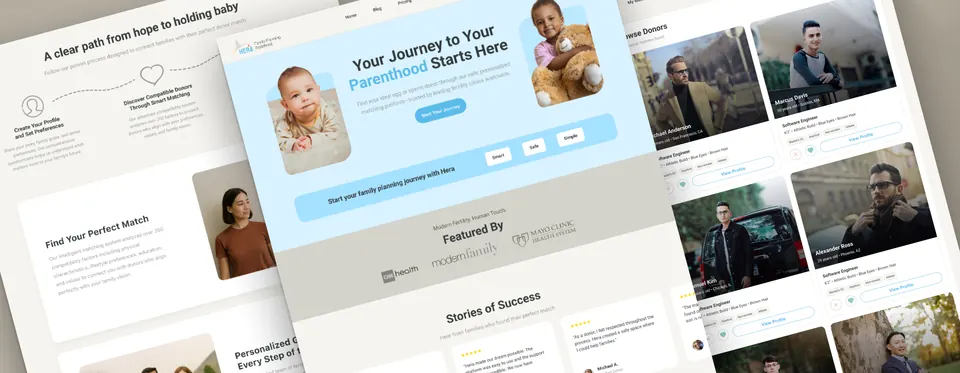
Hera is a matching platform for family building. It connects intended parents with surrogates, egg donors, and sperm donors, and it carries the relationship the whole way: profiles that describe background, values, and preferences; compatibility matching across physical characteristics, education, lifestyle, and location; verification and health screening for donors; secure messaging; and coordination with fertility coordinators, counselors, and clinics.
Phase one built that as a web platform. The engineering work was mostly about two things that pull against each other — search that is genuinely expressive, and privacy that never leaks. Intended parents needed to filter across many traits at once. Donors needed certainty that their profile was not being browsed by anyone who had not been verified, and that a conversation stayed inside the platform.
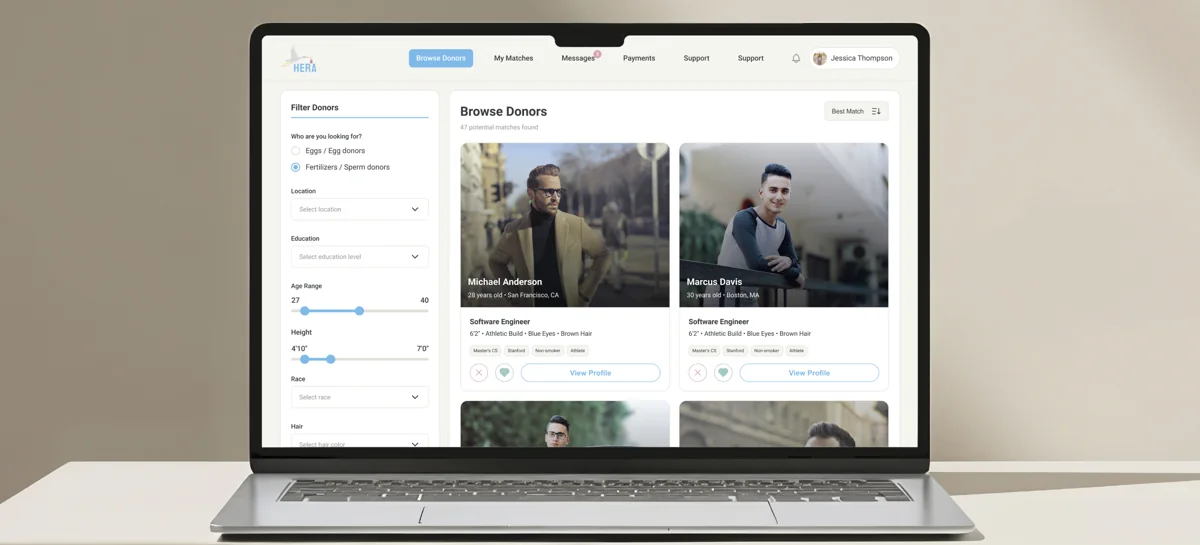
What shipped was a scalable matching layer with advanced filtering and secure communication channels, running on a mix of managed services rather than one monolith — Bubble.io and Cloudflare at the front, Lambda behind it, MongoDB Atlas and Wasabi for data and media, and Stripe, Daily.co, Checkr, and SendGrid for payments, video consults, background verification, and mail. Boring, deliberately. Every one of those pieces can be replaced without touching the matching logic, which is exactly what phase two depends on.
Why mobile is a phase, not a feature
Family building does not run on a desk schedule. A match arrives, a coordinator needs a document, a clinic opens a window for a screening appointment — and the person who has to respond is holding a phone, usually not at a desk, frequently not alone in the room. A responsive web page technically covers that. It does not cover it well.
Three things in particular only work properly as a native app:
- Time-sensitive notification. Matching is a two-sided market with real urgency. Email arrives whenever the inbox is checked; a push notification arrives when the match does.
- Capture from the device. Intake and verification involve documents and photographs. Photographing an ID or a clinic letter and submitting it in the same flow removes an entire desktop detour that people abandon halfway through.
- Privacy in the hand. A phone is a shared and glanceable object. Biometric unlock, no sensitive content in notification previews, and encrypted local storage are things you can only really do from inside an app.
What phase two delivers
The mobile platforms bring iOS and Android onto the same matching layer the web runs on, rather than shipping a reduced companion app. React Native was already part of Hera's stack for this reason — one codebase across both stores, and an API-first boundary that means a change to matching logic lands everywhere at once instead of three times.
- Full matching parity — the same profiles, filters, and compatibility criteria as the web platform, laid out for a small screen instead of squeezed into one.
- Push notification for new matches, messages, verification status, and coordinator requests, with the substance held behind the unlock rather than shown on the lock screen.
- In-app messaging and video, so introductions and consults stay inside the platform on mobile as they do on the web.
- Document and photo capture for intake and verification, uploading straight to the same secure store.
- Biometric app lock, minimal data at rest on the device, and no protected health information in push payloads.
- Offline tolerance — drafts and partially completed profiles survive a dropped connection, which matters when half of this happens in clinic waiting rooms.
The performance targets are the unglamorous half of the work: cold start under two seconds on mid-range Android hardware, list scrolling that stays at frame rate with image-heavy profiles, and accessibility that holds up with larger type sizes, because the audience for this product is not uniformly twenty-five.
Phase three: AI-assisted advanced screening
The next phase, already in design, brings AI into screening — and it is worth being precise about what that means, because in a fertility context the wrong phrasing describes a product nobody should build.
It is decision support, not decision making. The models work on the paperwork and the structure of a match, not on a clinical verdict:
- Structuring intake. Screening questionnaires, clinic letters, and lab documents arrive as scans and free text. Extracting that into consistent fields is the single largest source of coordinator time in the current process.
- Completeness and consistency checks. Flagging a missing document, an expired result, or a field that contradicts another one — before a match is presented rather than after.
- Explainable compatibility ranking. Ordering candidate matches by the criteria a family actually stated, and showing which factors drove the ranking. A ranking nobody can explain is not usable in this domain.
- Escalation, not exclusion. Anything that looks like a clinical or eligibility concern routes to a human coordinator or clinician. The system never rules a person out.
Every suggestion carries its source, every action stays auditable, and licensed professionals keep the decisions. The screening data itself stays inside the platform's existing privacy boundary — the point of the AI layer is to remove hours of transcription from coordinators, not to move sensitive records somewhere new.
What we are showing in October
At LA Tech Week we will walk through the mobile platforms and the architecture underneath them, including the parts that did not go smoothly. If you are building in fertility, health tech, or any two-sided market where trust is the product rather than a feature, that second category is usually the more useful conversation.
If you cannot make the week, the same walkthrough is available directly — get in touch, or look at how the mobile practice approaches this kind of build.
