


How South Bay Coders Built TheraPro to Solve the Biggest Challenges in Modern Therapy
Physical therapy clinics do not have a software shortage. They have a fragmentation problem. Scheduling lives in one system, documentation in another, home exercise programs get printed or emailed as PDFs, and the operational picture of the business lives in a spreadsheet somebody maintains by hand.
TheraPro was built to collapse that stack into a single clinic management platform, designed around how therapists actually work rather than how billing systems prefer to be fed.
The problems we set out to solve
- Documentation burden. Therapists were finishing notes after hours. Every minute of charting is a minute not spent treating.
- Home exercise adherence. Printed sheets get lost. Patients who cannot remember the movement stop doing it, and outcomes suffer.
- Program consistency. Protocols lived in individual therapists' heads, so care varied by who was on shift.
- No operational visibility. Owners could not see utilization, no-show patterns, or plan-of-care progress without assembling it manually.
What we built
The platform is organized around a program hierarchy: a plan of care contains sessions, sessions contain exercises, and every exercise carries its own guide with illustrated instructions, sets, reps, and progression rules. Clinicians assemble a program once and reuse it, with room to tailor per patient.
Patients get the same program on their own device — with the visual guide attached to every movement, not a filename they need to interpret. Completion flows back to the clinic, so a therapist walks into the next appointment knowing what actually happened between visits.
On the clinic side, the platform covers scheduling, patient records, program assignment, progress tracking, and a support console for the operational questions that inevitably come up during a busy day.
Why the architecture matters
TheraPro is built on a low-code application layer with AWS infrastructure handling the workloads that need real compute — document generation, scheduled synchronization, and media delivery. That split is deliberate. The interface layer can change weekly as clinic feedback arrives, while the heavy lifting runs on infrastructure built to scale.
The clinics that adopted early did not ask for more features. They asked for fewer places to look. That shaped every decision after.
Built to be branded
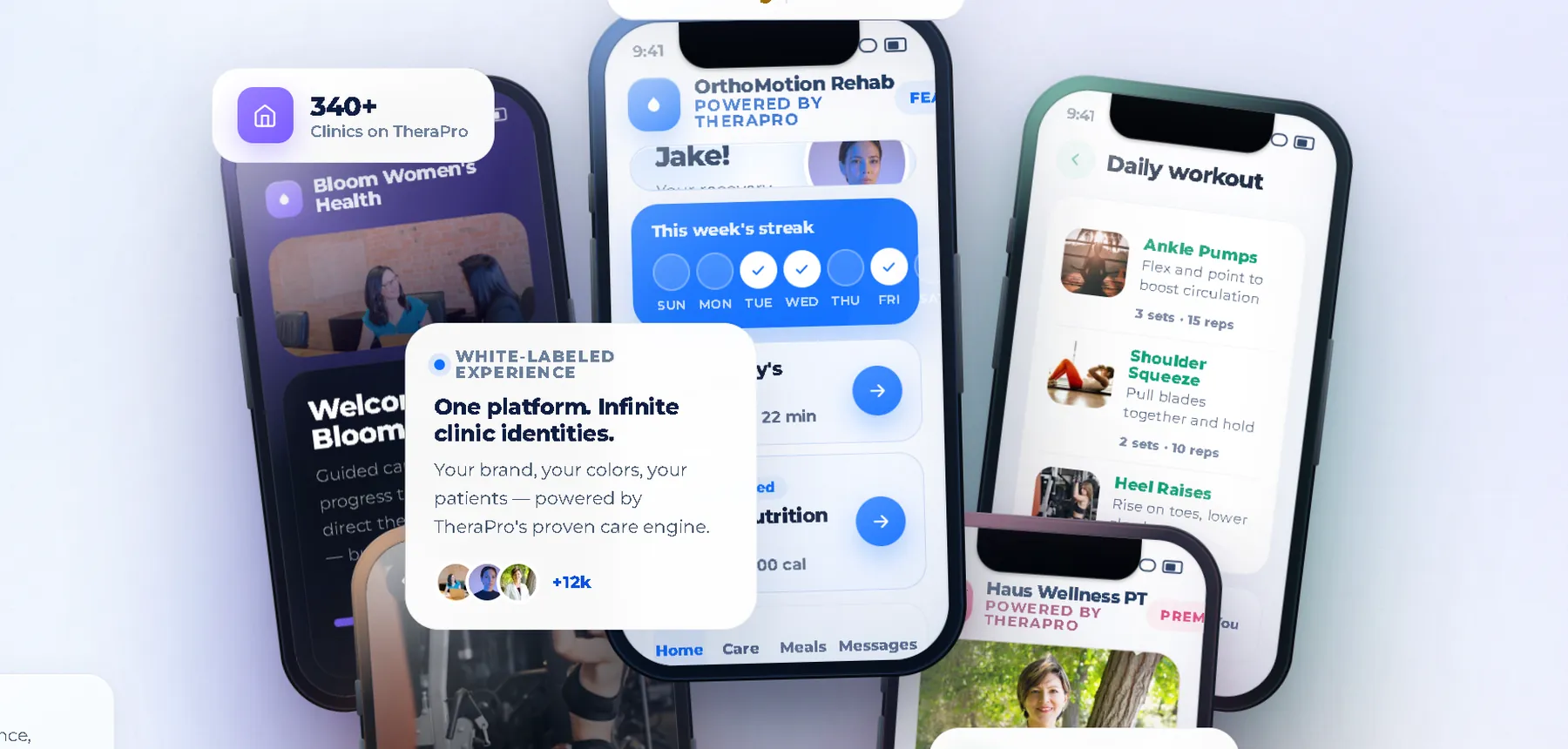
Larger therapy groups do not want to hand their patients a third-party app. TheraPro supports white-label deployment, so a practice can put its own identity in front of patients while running on the same platform underneath.
TheraPro is a working example of how we approach product engagements generally: understand the operational reality first, ship something clinicians can react to quickly, and let the architecture follow what the users prove they need.